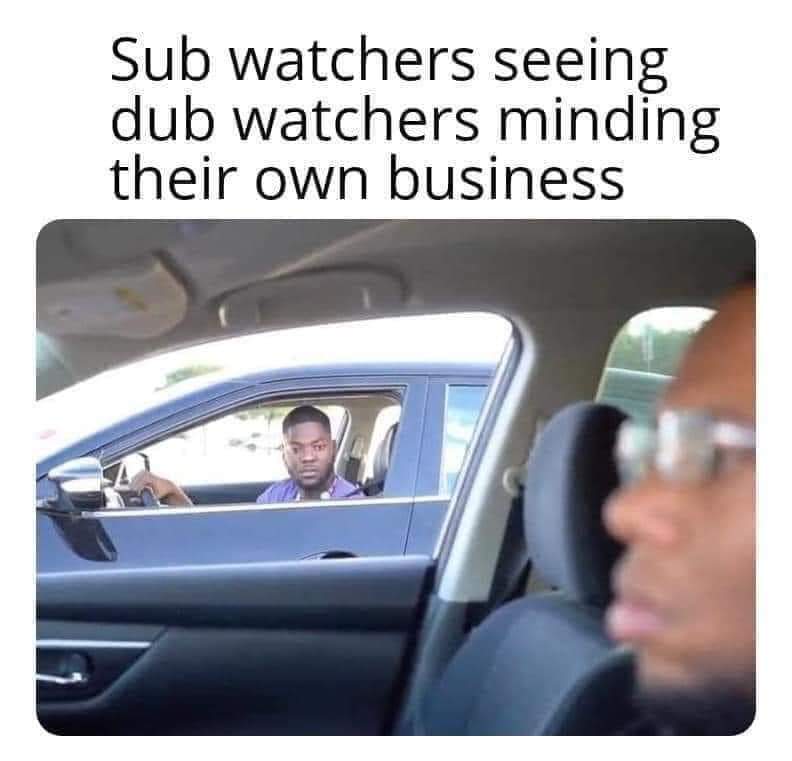
Dub vs. Sub. An age old debate between anime fans all over the globe. Why does this debate exist? Why are we like this?
Before delving into this controversial topic, people need to understand that individuals have their preferences. Whether you like watching your anime subbed or dubbed, you are still consuming the same media, just translated and adapted differently for the respective languages. I would like to warn people that this blog is written to give a different perspective about consuming anime in English dub.
Now that we have an idea about the purpose of this blog, let’s get to unpacking and unlearning the dislike and disdain of English dub. As this is your first and last warning, if you are a sub watcher and you prefer subs, that’s perfectly fine! What you’re not going to do in my comments and replies on my social media, is talk about how dub is whack. We aren’t here to shame either means of consumption. We are here to learn; we are here to elevate and celebrate the work that dub voice actors put into anime. We are here to gain understanding.
This blog is based on my observations of the anime community. I am not qualified to speak on industry stuff, but I do know someone who discusses the English dub of anime a bit more in depth than I would. Please check out The Cartoon Cipher and their archive of dubbed anime that they’ve analyzed. Also, check out actual dubbed actors, ADR people, and many many more staff behind dubbing an anime. They are the most reliable source to understand the dubbing industry.
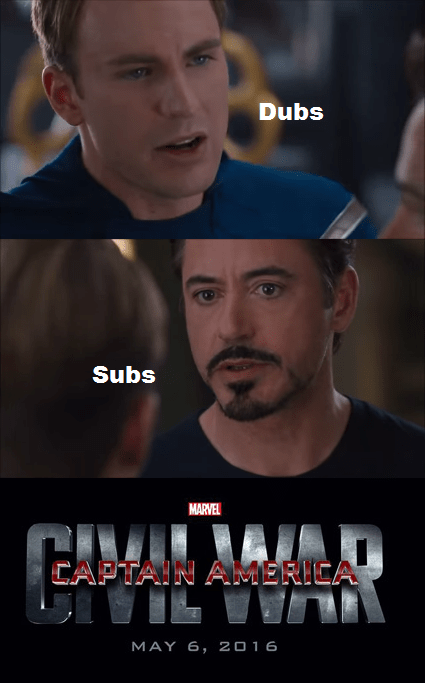
1. The Availability of Anime to the Western Audience (US Market)
How many of you grew up watching anime in the 90’s and early 2000’s? For those who raised their hands or said “I did,” how many of you consumed anime from one of the following channels?
- Kids WB!/4Kids/Toonzai
- Fox Kids
- Toonami
- Jetix
- Anime Network on Demand
If you said yes to any of these, I thought so. If you said through imported VHS tapes, this still applies to you since you’re still a consumer of the medium. When we were growing up, the availability of anime existed, but took forever to come here unless you were a staple title such as Dragon Ball or Pokémon, just to name a few. Now in the age of technology with services such as Crunchyroll, Netflix, Hulu, HBO Max, the new player in this game Disney+, and other streaming sites; we have many different ways to watch anime. Even YouTube depending on the studio or streaming service that has an account up on that platform may have all or part of the series up.
I’m also assuming that based on the prior question I asked, you watched anime in English, right? Because that’s what was available to us during that time, right? Again, I thought so. We cannot deny our roots as Western consumers.
Now that we have more movies coming to the states such as Belle, Jujutsu Kaisen 0, Fruits Basket: Prelude, and even Kaguya-sama Love Is War: The First Kiss That Never Ends (where the first three aired last year and Kaguya-sama’s movie will air on February 14th and 15th, 2023 in select theaters), we have to thank the dub for this. Yes, we should also thank the Japanese market because theaters end up making box office records like Demon Slayer: Mugen Train did back in 2021. But you should also thank the hundreds of dub actors who present you with the gas known as your favorite series.
Adaptations for all to enjoy are amazing, and I’m sure you were longing for someone to enjoy this medium with. Do me a favor, just like the Jump Festa 2022 that took place in December 2021 when Bleach’s return as the final arc, Thousand Year Blood War is being adapted: Revert Your Roots; it’s time to remember where you came from.
2. The Accessibility of Anime to the Western Audience
For those of you who do not know, in my muggle life, I am a program manager for day services for people with developmental disabilities. There are a large handful of my current and former clients that watch anime. There are even times where I bump into them at conventions, parties, or any other anime related event. I even taught a class about anime from watching random clips to discussing different studios, and even had them list their favorite series.
One thing I did notice one day when I presented a Soul Eater theme song, Paper Moon by tommyheavenly6, one of my clients sang along in English while I sang in Japanese. That was a jam session I never thought would ever happen.
But back to the point, Closed captions originally existed as an accessibility tool. Some people cannot process audio alone and need the visuals to help them understand what a show is saying. Dubs exist out there for people to process a story no matter how simple or difficult. People end up enjoying themselves and feel included.
We also need to remember: not everyone can process a different language easily or read and listen at the same time to a different language. If you’re reading what I’m saying about this and still feel whatever about it, there’s unchecked ableism that needs to be addressed.
Just because something exists and you find it pointless or should be nixed, does not mean that its purpose is not intentional at all.
3. Language Barriers Exist
In point #2, I mentioned that not everyone can process a different language so easily. What if you spoke one language and tried your hardest with watching anime or other media in another language?
A lot of the sub supremacists do not speak or are not learning Japanese, yet alone another language. I also know that the argument that will be held against me is “well, the emotions that they carry are better.” Here’s why that rebuttal needs to stop:
- You’re discrediting the hard work English voice actors are putting into a series.
- You’re putting Japanese voice actors on a pedestal when they are human beings like the rest of us.
- For those who do not know Japanese that well, stop acting as if you know what is being said fully. Subtitles are translated and Japanese is a contextual language. Even if the translation is correct or near 100%, there are still nuances that are there can can only be fully understood if you know the language.
My best friend wants to get into more anime, however she would rather watch it dubbed because the story would be easier understood that way. With simulcasts and series that aired in the past five or so years, she and other watchers can enjoy the same story as sub watchers have.
At the end of the day, you are watching the same media no matter the language.
4. Nostalgia is Holding You Back
We are now in the year 2023. If I hear or see anything about how you don’t like dubs because they sound terrible back then, you sure as heck did not watch dubs within the past five or so years.
We are not in the 1990’s or early 2000’s anymore. There are newer talent that exist now that also grew up watching anime dubbed. Some were even trained by those same voice actors we grew up listening to. We also have more diverse cast members in dub acting. More Black and other POC are being hired and more LGBTQIA+ people are being hired. We get to hear even more range and variety of voice acting styles. Get it together people.
I also know that people will ask me how I watch anime. The answer may shock you…
It depends on the series. For the most part, I watch anime subbed because it is available first when anime air seasonally. I’m also more familiar with the Japanese voice acting scene and know more names and roles done as opposed to the English voice acting scene. Whenever I have the chance and time, I watch anime dubbed. I also watch dubbed anime when the series is bit too intensive for me to process auditorily. Vinland Saga is a perfect example of this. If the dub was available when it first aired in 2019, I would have been a bigger fan that I am now.
Conclusion
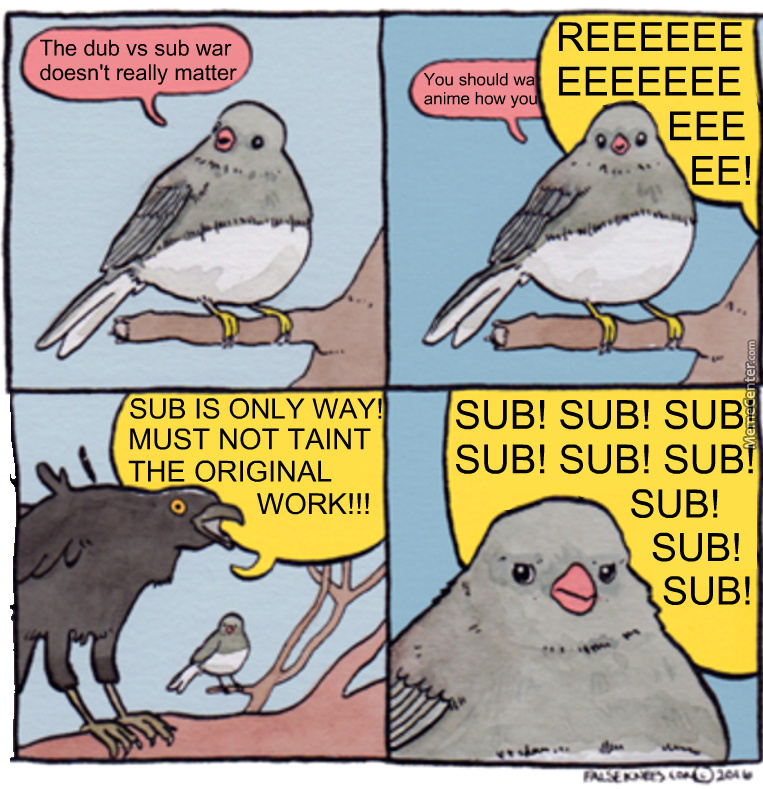
As stated at the beginning of this blog, you can have your preference. But don’t disrespect the work English VAs put into their craft. Also, curb your enthusiasm if you see someone watching dub. You may not know what they are going through, and you should really mind your business. At the end of the day, we are all watching the same thing. It just so happens that the language differs. If you have learned something from this blog, please consider following me on my socials. Thank you all for reading, and stay tuned for the video version of this blog.


Leave a reply to Lisa De La Cruz Cancel reply